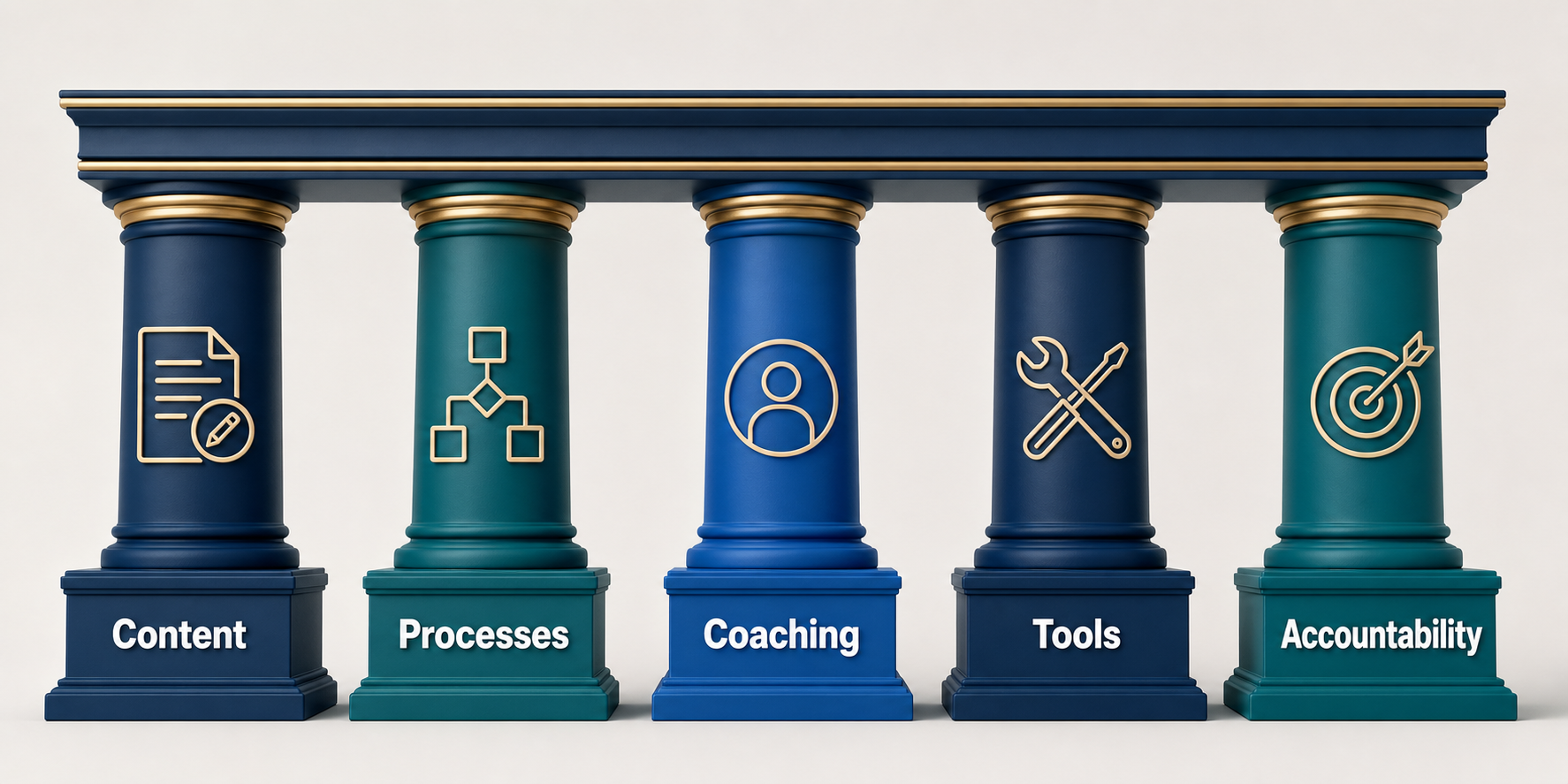
The 5 Pillars That Hold An Enablement Function Together
If you ask ten people what "revenue enablement" means, then you'll most certainly get ten different answers. Usually, it’s some version of "training" or "the deck library." And while that’s not exactly wrong, it is only a small portion of the picture.
After years of building this function inside different companies, I keep coming back to the same architecture. It wasn’t because I set out to invent a framework, although I do like how frameworks make things repeatable and scalable, it was because every time I've walked into an enablement mess, the diagnosis was surprisingly similar. In nearly every case at least one of five pillars was missing entirely, and the other four were trying to compensate for it.
So, today, I will share a breakdown of these pillars, what each one actually covers, and what it looks like when it's not there. You’ll notice that “training” is not one of the 5 pillars, and that is because it is woven into each pillar.
Content
This is the assets, the product knowledge, and the messaging. All the battlecards, one-pagers, pitch decks, and competitive positioning that live in your intranet or LMS. To be fair, it’s also the part everyone thinks of first when they hear "enablement," and because of this, it's the pillar most companies over-invest in relative to the other four. Content is very visible, you can point to it in a board deck, and you can block off time on a calendar for training on it. "We built 40 new assets this quarter" sounds like progress.
But content has no mechanism of its own for getting used correctly. A shared drive full of decks nobody opens is a sign the other pillars aren't there to give the content a job. Good content answers a real question a rep has in a real moment, but most content libraries are organized around what the company wants to say, instead of around the moment a seller actually needs it.
Process
These are the playbooks, methodologies, frameworks, and explanations on how opportunities actually move from stage to stage. In my experience, this pillar is skipped most often because process feels like bureaucracy, and no one like red tape. But this quickly changes when it's the only thing standing between a good rep and a bad quarter.
Without documented process, your best people build their own systems in their heads. When they get promoted or leave, the system leaves with them, and the person who replaces them starts from zero instead of inheriting something proven. Process is what turns one person's instinct into an organization's capability. It's also the piece I see leadership resist hardest, because writing the process down means admitting the current approach depends entirely on who's doing it.
Coaching
I want to be clear that this is not and should not ever be conflated with "sales training." Coaching is ongoing, individualized development over time around things like messaging quality, meeting quality, and skill-building. This is where content and process either take hold or don't. You can hand someone a clear playbook and a great deck and still watch them fail because nobody ever coached them on how to actually use them in a live, high-pressure conversation.
A few things I hold as non-negotiable here, because they get skipped constantly, are that coaching sessions and coaching actions are not the same thing. Listening to a call recording together is a coaching action, it is observation. It is not a coaching session unless there's a structured conversation attached to it. Managers should be spending something close to half their time coaching, not a stray hour when the calendar happens to clear. And feedback needs a filter, or it turns into noise that is ignored. I use RANT — Relevant, Actionable, Necessary, Timely to keep coaching sharp instead of generic. Something like "good job on that call" fails all four of those tests. It’s much more valuable to say "in the second objection at 14 minutes, you moved to price before you'd confirmed the business impact, so try anchoring the value first next time".
Just like an athlete isn’t just coached after a game, coaching also isn't a one-time event bolted onto onboarding or handled in the team call after a training session. It runs on a cadence of weekly 1:1s, monthly team sessions, and quarterly playbook reviews. Remember: skill decays the moment reinforcement stops.
Tools
These are things like walkthroughs, evergreen guidance docs, and how your tech stack fits together. Unfortunately, tools get treated as a shopping list. Just buy the CRM, buy the sales intelligence platform, buy whatever the review site ranked highest this quarter, or even buy this persona’s favorite solution. That's how you end up with tool fatigue. A stack of individually excellent tools that nobody fully adopts because switching between six systems costs more attention than any one of them saves.
A tool is only as good as the process and content it's wired into, and the willingness and ability for users to use it. The best CRM in the world doesn't fix a broken opportunity process; it just gives you a faster, better-documented version of the wrong process. Tool selection should follow process design, not the other way around, and almost every company I've walked into has that order reversed.
Accountability
This is 1:1s, metrics, cadence, and goals. This is the pillar that turns the other four from "nice to have" into "actually happens." Without accountability, content goes stale because nobody's tracking whether its still accurate, process gets ignored the first time someone's busy, coaching becomes optional, dependent on a manager's mood or bandwidth that week, and tools get half-adopted because there's no consequence for working around them.
We need to understand that accountability isn't a punishment layer. Too many organizations treat it that way, though, and that is exactly why some leaders avoid building it. In the wrong culture it feels like surveillance instead of infrastructure, but it’s the thing that keeps the rest of the system honest. For instance, a cadence of 1:1s and a clear set of metrics shouldn’t exist so you can catch people failing. They exist so failure and success get noticed early and then acted on. That way you can share best practices with your teams, and keep quarterly numbers from being a surprise.
How they interact
The part that matters more than any single pillar is that they hold each other up.
Great content without coaching is a library nobody opens.
Great process without accountability is a suggestion that’s followed when convenient but abandoned under pressure.
Great tools without process are expensive graveyards.
Great coaching without content is a manager repeating themselves from memory instead of pointing to a shared source of truth.
Accountability without any of the other four just measures the absence of a system and calls it a performance problem.
I see this exact failure pattern in onboarding specifically. The standard sequence should be: ground people in who they're selling to and why it matters, then the product, then the process, then the tools. Most programs skip straight to process and tools because that feels like faster ramp. But if you skip the foundation then everything after it sits on nothing.
How to actually use this
I run a simple green/yellow/red read on each pillar to figure out where a team really stands
Green means it's built and holding
Yellow means it exists but is inconsistent or unowned
Red means it's effectively missing
I'll go deeper on that diagnostic in a future post, but you can start applying the logic right now with five honest questions:
Content: if a rep needs the right asset in the next five minutes, do they know exactly where to find it or are they searching, or building it themselves?
Process: if your best rep left tomorrow, would their approach survive in writing, or does it leave with them?
Coaching: are your managers having structured, individualized development conversations on a real cadence or are "coaching actions" like call listens getting counted as coaching?
Tools: did your current stack get chosen to fit a documented process, or did the process get bent to fit whatever you'd already bought?
Accountability: if a pillar started crumbling today, would you find out this week or would it show up as a missed number next quarter?
Most enablement problems aren't content problems, or tool problems, or coaching problems in isolation. They're architecture problems where one pillar is missing while the other four try to cover for it.